It may only stretch to three letters, but your RCD (or residual current device) is vital to your electrical safety as it will automatically shut down your electricity should a fault arise. It has a higher level of sensitivity than a standard fuse or a circuit breaker, so it really can save lives.
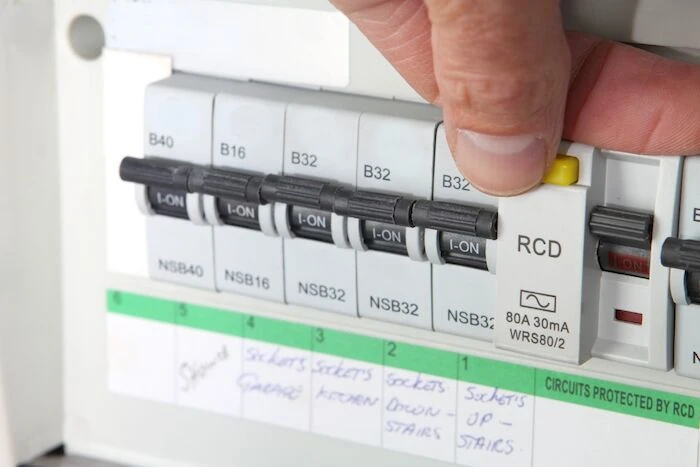
Fundamentally, an RCD is designed to monitor the flow of electricity round a circuit and to trigger if it senses that power is taking a path it’s not intended to. For example, this might be that it’s travelling through a human being who’s come into contact with a live part – and if that’s the case then the RCD’s job is to stop that flow instantaneously. RCDs come into their own in areas of the house or workplace where the risk from electrical shock or injury is at its greatest, such as kitchens, bathrooms and gardens.
As a result, it’s vital to ensure that the RCD functions correctly by testing it on a regular basis, especially if you’re frequently using electrical equipment in damp or wet conditions. Mowing wet grass can be hazardous if you cut through the mower cable and the intervention of the RCD in that scenario can literally save your life.
There are three types of RCD:
You’ll find a fixed RCD in your fusebox and that offers the highest level of protection against any malfunction in your electrical circuit(s) and any appliances and sockets on there. A socket RCD replaces a standard socket and offers protection when you’re plugging an appliance into it. And, finally, a portable RCD will plug into any normal socket, allowing you to plug an appliance into it.
RCDs are not completely failsafe, but they do offer around 97% reliability, which greatly reduces your risk of an electric shock or electrical fire within your property. That said, you still need to exercise caution and respect electricity because having a functioning RCD doesn’t remove the need to take care. We recommend that you test your RCD at least every six months to ensure it’s operating correctly. It’s easy to spot the test button in your fusebox as it will have the word ‘TEST’ or a ‘T’ on it. If the RCD fails to cut the electrical supply immediately then it should be repaired as a matter of urgency.
For Mark Smith, owner of MS Electrical Services, a simple RCD test every six months could be a godsend. ‘As of July 2008, standard BS 7671 has stipulated that the vast majority of newbuild or rewired homes must have an RCD, and it’s only by testing it on a regular basis that you’ll know whether it’s conforming to the standard,’ says Mark. ‘As well as having your electrical installation tested every ten years – or every five years in a rented property – we urge everyone to test their RCD at least twice a year, and to take remedial action should it not be functioning properly. As with everything in the electrical safety field, it’s far better to be safe than sorry.’
At MS Electrical we offer fixed wire testing in Cambridge. Should you have any concerns about your RCD or your electrical installation in general, please contact us for advice or to request a no-obligation quotation.